
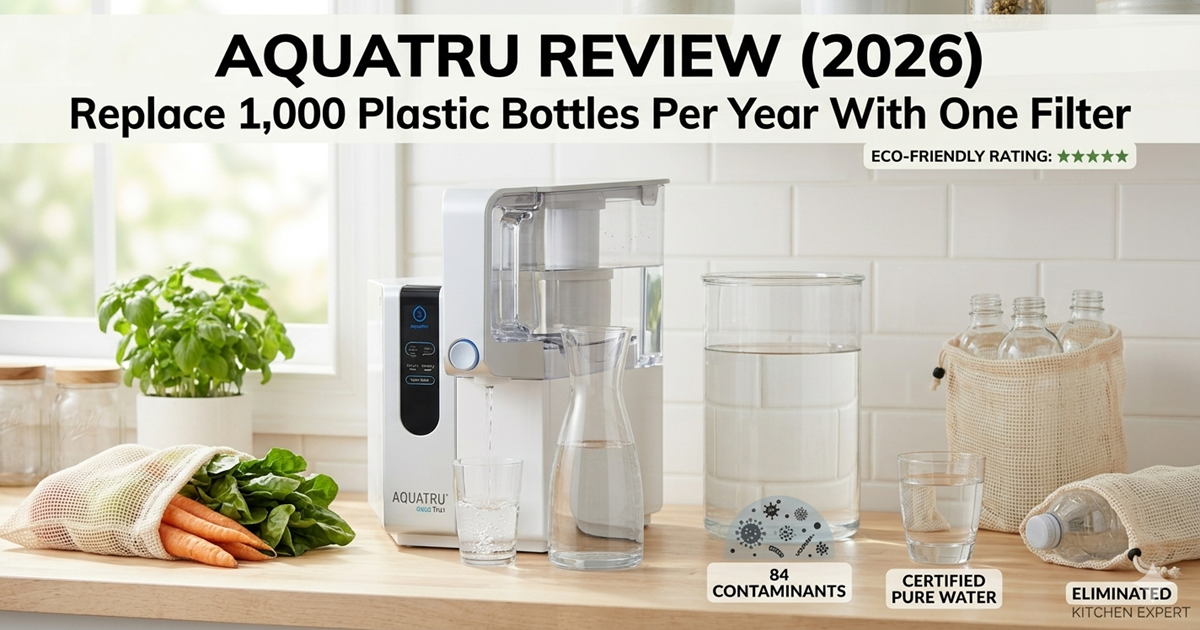
The AquaTru Classic is the best countertop reverse osmosis water filter in 2026 — certified by IAPMO to NSF/ANSI standards 42, 53, 58, 401, and P473, removing 84 contaminants including PFAS, lead, fluoride, and chlorine. At $449, it pays for itself within 18 months for households switching from bottled water, and eliminates approximately 1,000 plastic bottles per year for a family of four. The main limitation: it removes beneficial minerals along with contaminants, requiring remineralization drops for long-term use.
Most households that buy an AquaTru are doing so because they are spending $150–300 per year on bottled water — or because they have just read something alarming about PFAS “forever chemicals” in their tap water and want a certified solution. Both are valid reasons. But as an Environmental Scientist, I want to give you the complete picture that most AquaTru reviews skip: the plastic waste impact, the minerals problem, the wastewater calculation, and an honest assessment of whether the eco math actually works out in your favor.
Spoiler: for most households, it does. But not for the reasons most reviews give you.
🚚 Need Fast & Free Shipping on Your Kitchen Supplies?
Get fast, eco-friendly delivery and exclusive deals on top-rated sustainable tools with a 30-Day Amazon Prime Free Trial.
Try Amazon Prime Free for 30 Days →The NSF certifications are genuine, the PFAS removal is lab-verified, and the eco math works: one AquaTru replaces approximately 1,000 plastic bottles per year for a family of four. The $449 price pays back in under 18 months versus bottled water. The one caveat: add remineralization drops to restore beneficial minerals removed by the RO process.
📋 AquaTru Classic — Full Specs (2026)
| Models Available | Classic (~$449) · Carafe (~$449) · Connect (WiFi) · Alkaline |
| Filtration Type | 4-stage countertop reverse osmosis (RO) |
| NSF Certifications | NSF 42 NSF 53 NSF 58 NSF 401 NSF P473 (PFAS) |
| Contaminants Removed | 84 — including PFAS, lead, fluoride, arsenic, chlorine, nitrates |
| Tank Capacity | 1 gallon clean water tank (Classic) · 3.5L carafe (Carafe) |
| Filter Cycle Time | ~12–16 minutes per tank |
| Waste Water Ratio | 0.6:1 — produces 0.6L clean per 1L used (traditional RO: 3:1–5:1) |
| Electricity Required | ✅ Yes — standard outlet (pump-driven) |
| Installation | Zero — countertop, no plumbing required |
| Annual Filter Cost | ~$75–100/year |
| Filter Life Indicator | ✅ Yes — light indicator when replacement needed |
| Dimensions | 14″W × 14″D × 14″H (Classic) |
| Weight | ~10 lbs |
| Warranty | 1 year manufacturer warranty |
| Price | ~$449 (Classic) / ~$449 (Carafe) / ~$499 (Connect) |
🌿 The Real Eco Impact: 1,000 Plastic Bottles Per Year
This is the calculation no other AquaTru review has done — and it is the most important number for eco-conscious households.
The average American drinks approximately 2.5 bottles of water per day. For a family of four, that is 10 bottles per day — 3,650 bottles per year. Even conservative households buying one 24-pack per week generate 1,248 plastic bottles annually. The AquaTru Classic holds 1 gallon (approximately 8 standard water bottles worth) and can be refilled multiple times per day.
🌍 Annual Plastic Elimination Calculator — Family of 4
🔬 What AquaTru Actually Removes — The Science
The 4-Stage Filtration Process
Stage 1 — Pre-Filter: Mechanical filtration removes sediment, rust, sand, and particles larger than 20 microns. Protects the RO membrane from clogging.
Stage 2 — Activated Carbon Pre-Filter: Removes chlorine, chloramines, and volatile organic compounds (VOCs) that would otherwise damage the RO membrane.
Stage 3 — Reverse Osmosis Membrane: The core filtration stage. A semi-permeable membrane removes dissolved contaminants including heavy metals, fluoride, nitrates, arsenic, pharmaceuticals, and PFAS at the molecular level.
Stage 4 — Activated Coconut Carbon Post-Filter: Final polishing stage removes any remaining taste or odor compounds, including PFAS compounds that may have passed through the membrane.
| Contaminant | Removed? | Reduction Rate | NSF Certified? |
|---|---|---|---|
| PFAS (PFOA, PFOS) | ✅ Yes | >99% | ✅ NSF P473 |
| Lead | ✅ Yes | >99% | ✅ NSF 53 |
| Fluoride | ✅ Yes | 93.5% avg | ✅ NSF 58 |
| Arsenic | ✅ Yes | >99% | ✅ NSF 58 |
| Nitrates/Nitrites | ✅ Yes | >99% | ✅ NSF 58 |
| Chlorine | ✅ Yes | >99% | ✅ NSF 42 |
| Chloramines | ✅ Yes | >98% | ✅ NSF 42 |
| Pharmaceuticals | ✅ Yes | >97% | ✅ NSF 401 |
| Chromium-6 | ✅ Yes | >99% | ✅ NSF 58 |
| Microplastics | ✅ Yes | >99% | ✅ NSF 401 |
| Bacteria/Viruses | ✅ Yes | >99.9% | ✅ NSF 58 |
| Calcium/Magnesium (minerals) | ⚠️ Also removed | 85-95% | N/A |
⚠️ The One Problem Nobody Talks About: Minerals
This is the most important limitation of any reverse osmosis system — and almost no AquaTru review addresses it honestly. RO filtration removes contaminants by forcing water through a membrane that blocks particles at the molecular level. The problem: it cannot distinguish between harmful contaminants and beneficial minerals.
Calcium, magnesium, potassium, and other naturally occurring minerals — which your body needs — are removed at 85-95% efficiency alongside the lead and PFAS. The resulting water is essentially demineralized.
The Solution — Remineralization
Two options:
Option 1 — AquaTru Alkaline Model (~$499): Adds an alkaline remineralization filter stage that restores calcium, magnesium, and potassium after RO filtration. This is the most convenient solution and the model we recommend for long-term daily use.
Option 2 — Trace Mineral Drops: Add a small amount of food-grade ionic mineral drops to each tank of filtered water. Cost approximately $15-25 for a 6-month supply. Works with the standard Classic or Carafe models.
💧 The Wastewater Question — Is AquaTru Eco-Friendly?
Traditional under-sink RO systems waste 3–5 liters of water for every 1 liter of clean water produced — a significant environmental concern. AquaTru uses an electric pressure pump rather than relying on home water pressure, which dramatically improves efficiency.
| System Type | Waste Ratio | Clean per 10L Used | Wasted per 10L |
|---|---|---|---|
| AquaTru Classic ✅ | 0.6:1 | 6.25L | 3.75L |
| Traditional under-sink RO | 3:1 – 5:1 | 2–2.5L | 7.5–8L |
| Gravity filter (Berkey-style) | 0:1 | 10L | 0L |
| Pitcher filter (Brita) | 0:1 | 10L | 0L |
What to Do With AquaTru Wastewater
The wastewater from AquaTru is not toxic — it is simply concentrated tap water. Use it for:
- Watering houseplants (not edible plants if your tap water has high contaminants)
- Flushing toilets
- Cleaning floors and surfaces
- Pre-rinsing dishes before the dishwasher
🔍 AquaTru Model Comparison (2026) — Which One Should You Buy?
🔵 AquaTru Classic (~$449) — Best Overall
Standard 4-stage RO with 1-gallon clean water tank. Push-button dispenser. Best for households wanting core PFAS and contaminant removal. Add mineral drops for long-term use.
🟢 AquaTru Carafe (~$449) — Best for Small Households
Same 4-stage filtration as Classic but with a sleek 3.5L glass-look carafe instead of a tank. Better for 1-2 person households. Can be placed in the fridge. Available in Alkaline version.
🌿 AquaTru Alkaline (~$499) — Best Eco & Health Choice
Adds a 5th stage alkaline remineralization filter that restores calcium, magnesium, and potassium after RO filtration. This is the model we recommend for long-term daily use — eliminates the minerals problem completely.
📱 AquaTru Connect (~$499) — Best for Tech Users
WiFi-enabled model with app connectivity — tracks filter life, water quality, and sends replacement reminders. Same filtration as Classic. Worth the extra $50 if you tend to forget filter changes.
| Model | Price | Tank Size | Remineralization | WiFi | Best For |
|---|---|---|---|---|---|
| Classic | ~$449 | 1 gallon | ❌ Add drops | ❌ | Best value, families |
| Carafe | ~$449 | 3.5L | ❌ Add drops | ❌ | 1-2 person households |
| Alkaline ✅ | ~$499 | 1 gallon | ✅ Built-in | ❌ | Best long-term health |
| Connect | ~$499 | 1 gallon | ❌ Add drops | ✅ | Tech-forward users |
⚖️ AquaTru vs Competitors — Eco Kitchen Comparison
| Filter | Price | PFAS Removal | Fluoride | NSF Certs | Plastic Eliminated | Best For |
|---|---|---|---|---|---|---|
| AquaTru Classic ✅ | $449 | ✅ >99% (P473) | ✅ 93.5% | 5 certs | 1,000+ bottles/yr | Best overall |
| Brita Pitcher | $35 | ❌ Not certified | ❌ No | NSF 42, 53 | 1,000+ bottles/yr | Budget, low contaminants |
| ZeroWater Pitcher | $45 | ✅ Partial | ✅ Yes | NSF 42, 53 | 1,000+ bottles/yr | Zero TDS focus |
| Clearly Filtered | $90 | ✅ Yes | ✅ Yes | NSF 42, 53, 244 | 1,000+ bottles/yr | Pitcher + PFAS |
| Waterdrop King Tank | $170 | ✅ Yes | ✅ Yes | NSF 42, 53, 58 | 1,000+ bottles/yr | No electricity, off-grid |
| ❌ Berkey (2026) | $280+ | ⚠️ Unverified | ⚠️ Add-on only | None (EPA issue) | 1,000+ bottles/yr | Avoid — EPA controversy |
💰 Is AquaTru Worth $449? The Complete Cost Analysis
💰 10-Year Cost Comparison
🎯 Who Should Buy AquaTru — And Who Shouldn’t
- Currently buy bottled water regularly — payback within 18 months
- Are concerned about PFAS, lead, or fluoride in your tap water
- Live in an apartment or rental — zero installation required
- Want NSF-certified contaminant removal without a plumber
- Want to eliminate 1,000+ plastic bottles per year
- Are switching from Berkey after the EPA stop-sale
- Already have an under-sink RO system installed
- Live off-grid without electricity access
- Only need basic chlorine/taste improvement — a Brita costs $35
- Cannot wait 12-16 minutes per tank refill
- Have very limited counter space (14″ × 14″ footprint)
Frequently Asked Questions
Q: Does AquaTru actually remove PFAS?
Yes — AquaTru is certified by IAPMO to NSF/ANSI P473, which specifically covers PFAS (PFOA and PFOS) removal. Independent lab tests confirm greater than 99% PFAS reduction. This is the most important certification for households in areas with known PFAS contamination, which includes an estimated 200 million Americans.
Q: How long do AquaTru filters last?
Stage 1 (pre-filter): every 2 months (~$15). Stage 2 (carbon pre-filter): every 6 months (~$25). Stage 3 (RO membrane): every 2 years (~$45). Stage 4 (carbon post-filter): every 1 year (~$25). Total annual cost: approximately $75–100. AquaTru’s filter life indicator light tells you when each filter needs replacement.
Q: Does AquaTru remove beneficial minerals?
Yes — this is the most important limitation of any RO system. Calcium, magnesium, and potassium are removed along with contaminants. For long-term daily use, we strongly recommend the AquaTru Alkaline model (which adds minerals back) or adding ionic trace mineral drops to each tank of filtered water.
Q: How much water does AquaTru waste?
AquaTru has a 0.6:1 waste ratio — for every 10 liters of tap water used, it produces approximately 6.25 liters of clean water and 3.75 liters of wastewater. This is significantly better than traditional under-sink RO systems (which waste 3–5 liters per 1 liter produced). Use the wastewater for plants, toilet flushing, or floor cleaning to minimize waste.
Q: Is AquaTru worth it compared to a Brita?
Depends on your water quality concerns. A Brita removes chlorine and improves taste — ideal if your tap water is already safe and you just want better flavor. AquaTru removes 84 certified contaminants including PFAS, lead, fluoride, and arsenic that Brita cannot touch. If you have specific contamination concerns or are currently buying bottled water, AquaTru is worth the premium.
Q: Can AquaTru replace bottled water?
Yes — this is exactly what it is designed for. AquaTru water consistently scores better than major bottled water brands in TDS (total dissolved solids) and contaminant tests. Independent Tap Score lab tests confirm PFAS, lead, and microplastics to non-detectable levels — comparable to or better than premium bottled water at approximately $0.03 per liter versus $1–3 per liter for bottled water.
Q: How noisy is AquaTru during filtration?
AquaTru produces a moderate hum from the electric pump during the 12-16 minute filtration cycle — comparable to a quiet dishwasher. It is not silent, but most users run it while cooking or doing other kitchen tasks. It is significantly quieter than a dishwasher or washing machine.
Q: Is AquaTru good for the environment?
Yes — significantly more eco-friendly than bottled water. One AquaTru eliminates approximately 1,000–4,000 plastic bottles per year depending on household size, saving 25–110 lbs of plastic and 150–280 kg of CO₂e annually. The 0.6:1 wastewater ratio is the best available for countertop RO systems. The main eco consideration is electricity use — approximately 30–50 kWh per year, costing $5–9 in electricity at average US rates.
🏆 Final Verdict: AquaTru Review (2026)
| Factor | Score | Notes |
|---|---|---|
| Contaminant Removal | ⭐⭐⭐⭐⭐ | 84 NSF-certified — best in countertop category |
| PFAS Removal | ⭐⭐⭐⭐⭐ | NSF P473 certified, lab-verified >99% |
| Eco Impact | ⭐⭐⭐⭐⭐ | Eliminates 1,000+ plastic bottles/year |
| Ease of Use | ⭐⭐⭐⭐ | Simple — minor inconvenience of 12-16 min refill time |
| Value for Money | ⭐⭐⭐⭐ | Pays back in 18 months vs bottled water |
| Minerals Issue | ⭐⭐⭐ | Requires remineralization — buy Alkaline model |
| Wastewater | ⭐⭐⭐⭐ | 0.6:1 ratio — best for countertop RO |
| Overall | ⭐⭐⭐⭐⭐ | Best countertop water filter in 2026 |
Related Articles
- Best Compostable Trash Bags (2026) — Eliminate Kitchen Plastic
- Best Dissolvable Cleaning Tablets (2026) — Replace Plastic Spray Bottles
- Lomi Composter Review (2026): Is It Worth $500?
- Vitamix Blender Review (2026): Which Model Is Worth It?
- Plastic Free July 2026: Complete Kitchen Challenge Guide
Affiliate Disclaimer: This post contains Amazon affiliate links. If you purchase through these links, I earn a small commission at no extra cost to you. I only recommend products I have personally researched and believe in. This review was not sponsored by AquaTru.