
By Md. Mehedi Hasan, Environmental Scientist. Updated October 2026.
Affiliate disclosure: As an Amazon Associate I earn from qualifying purchases, at no extra cost to you. This guide is based on certification standards, manufacturer information and published product listings. I have not lab-tested these bags myself.
The 60-Second Answer
- If you have a backyard compost bin, look for a bag certified for home composting (the TÜV Austria “OK compost HOME” mark is the one to check). Many bags labeled “compostable” are not certified for home bins.
- If your city collects food waste, an industrial-compostable bag (ASTM D6400 or EN 13432, often BPI-certified in the US) is usually accepted, but check your local program first.
- Avoid bags that say only “eco-friendly”, “green” or “biodegradable” with no certification. These terms have no legal standard.
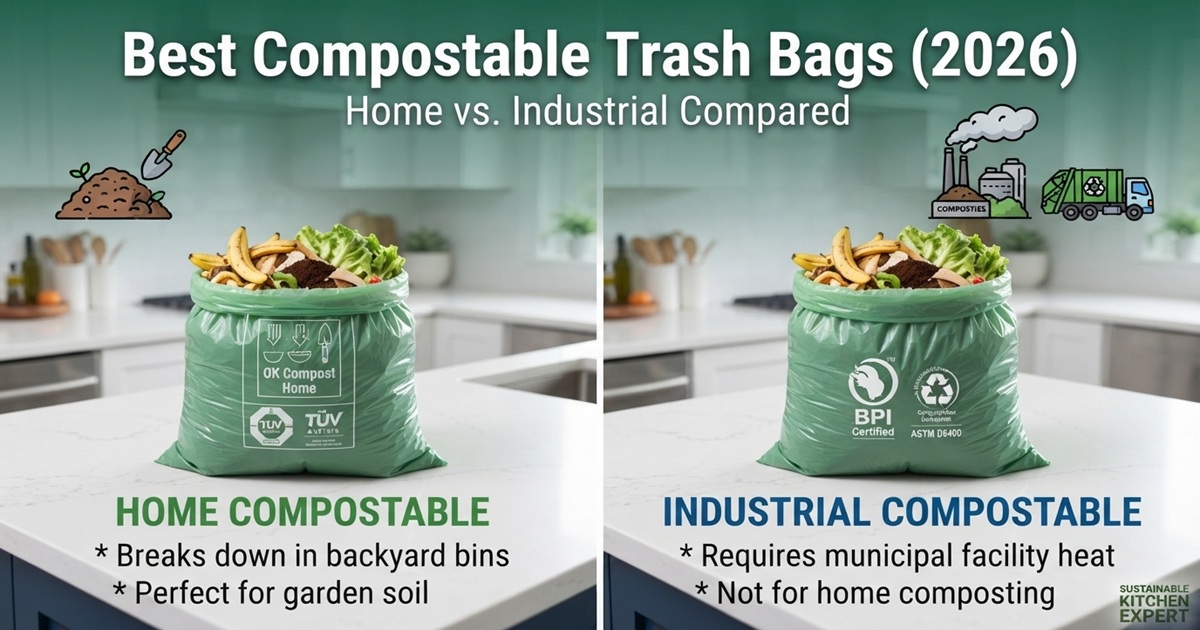
Compostable trash bags break down only under specific conditions. Most certified bags need an industrial composting facility, which reaches much higher temperatures than a backyard bin. Only bags with a home-composting certification are designed to break down in a backyard compost pile, and even those take months, not weeks.
🚚 Need Fast & Free Shipping on Your Kitchen Supplies?
Get fast, eco-friendly delivery and exclusive deals on top-rated sustainable tools with a 30-Day Amazon Prime Free Trial.
Try Amazon Prime Free for 30 Days →Compostable vs Biodegradable vs Oxo-Degradable
These words are often confused, and the confusion matters for your purchase.
| Term | What it means | Conditions needed | Verdict |
|---|---|---|---|
| Compostable | Breaks down into compost within a set time under a certified standard | Usually an industrial facility | Good, if certified |
| Home compostable | Certified to break down in a backyard compost bin | Home compost conditions, often 6 to 12 months | Best for backyard bins |
| Biodegradable | Will eventually break down; no fixed timeframe or standard | Unspecified | Not enough on its own |
| Oxo-degradable | Breaks into small plastic pieces (microplastics) under UV and heat | UV and heat | Avoid |
Scroll the table sideways on a phone to see all columns.
Certifications That Matter
Check the bag’s packaging for one of these marks, then look up the certificate number in the certifier’s public directory before buying.
| Certification | Issued by / standard | What it covers | Home bin? |
|---|---|---|---|
| OK compost HOME | TÜV Austria | Breakdown in home compost conditions | Yes |
| ASTM D6400 | ASTM (US standard) | Breakdown in industrial composting conditions | No |
| EN 13432 | European standard | Breakdown in industrial composting conditions | No |
| BPI Certified | Biodegradable Products Institute (US) | Verifies ASTM D6400 compliance for listed products | No |
| Seedling logo | European Bioplastics | Verifies EN 13432 compliance | No |
Standards and certifiers can update their rules. Confirm current requirements on each certifier’s website.
Home Composting or Industrial? Decide First
Choose a home-compostable bag if you run a backyard bin and your city does not collect food waste. Look for OK compost HOME.
Choose an industrial-compostable bag if your city has a food-waste or green-bin program that accepts compostable bags. Check your municipality’s rules first, because some programs accept only specific bag types.
Choose neither if your program accepts only food scraps. In that case, a bag may not be needed at all, and a compostable bin liner can be enough.
Brands to Consider
The brands below are commonly sold on Amazon and appear in certification directories. This is not a ranking. Before you buy, confirm the certificate for the exact size you need, because certifications can differ between sizes of the same brand.
BioBag (kitchen bags)
Price tier: $$. Certification to verify: ASTM D6400 and EN 13432 (industrial). Check whether any size carries a home-compost certification. Do not assume it does.
Best for: people with industrial collection who want a widely available brand.
AIRNEX Compostable Bags
Price tier: $$. Certification to verify: confirm both BPI and OK compost HOME for the exact size you buy, in the certifier directories.
Best for: backyard composters who also want an option that works in industrial collection.
If You Care Certified Bags
Price tier: $$. Certification to verify: OK compost HOME and EN 13432 for the listed sizes.
Best for: backyard composters on a moderate budget.
UNNI 100% Compostable Bags
Price tier: $. Certification to verify: ASTM D6400 and BPI for the sizes listed. Confirm home-compost status separately.
Best for: budget buyers with industrial collection.
Green Paper Products Compostable Bags
Price tier: $$. Certification to verify: ASTM D6400 and BPI for the sizes listed. Check the materials statement on the manufacturer’s page.
Best for: buyers who want clear information about materials.
Glad Compostable Bags
Glad sells several compostable lines, including ForceFlexPlus Compostable. Glad’s compostable products are generally labeled for industrial composting. Check the packaging: if the bag does not show a home-compost mark, assume it is for industrial collection only. Glad is widely available, so the question is usually which program you have, not which store you visit.
Price tier: $$. Best for: heavy kitchen waste with industrial collection.
Quick Comparison
← Swipe the table sideways to see all columns →
| Brand | Certification to verify | Home bin? | Price tier | Best for |
|---|---|---|---|---|
| BioBag | ASTM D6400, EN 13432 | Verify per size | $$ | Industrial collection, wide availability |
| AIRNEX | BPI, OK compost HOME | Yes, if listed | $$ | Backyard composters |
| If You Care | OK compost HOME, EN 13432 | Yes, if listed | $$ | Backyard composters on a budget |
| UNNI | ASTM D6400, BPI | Verify separately | $ | Budget, industrial collection |
| Green Paper Products | ASTM D6400, BPI | Verify separately | $$ | Clear materials information |
| Glad | Industrial certifications | Generally no | $$ | Heavy waste, industrial collection |
Price tiers are rough guides ($ lower, $$ higher). Check live prices on Amazon before buying.
How to Dispose of Compostable Bags Correctly
Industrial composting
- Check whether your city or county collects food waste and accepts compostable bags.
- Use only the bag types your program lists as accepted.
Home composting
- Use only bags with a home-compost certification.
- Cut bags into smaller pieces and keep the pile moist and aerated.
- Expect months, not weeks. Home conditions vary, so decomposition times differ.
Do not put compostable bags in recycling bins. They contaminate the recycling stream.
Frequently Asked Questions
Are compostable trash bags as strong as regular plastic bags?
Certified compostable bags vary in strength. Thicker bags handle wet waste better. Check the product’s stated thickness, and do not overfill or leave a full bag in a hot car or damp area for long.
Can I put compostable bags in my regular trash?
You can, but they will usually end up in a landfill, where they do not break down properly. The benefit only comes if they are composted.
Do Glad’s compostable bags break down in a backyard compost bin?
Glad’s compostable products are generally labeled for industrial composting. Check the packaging for a home-compost certification. If none is shown, assume the bag needs an industrial facility.
Which bag should I choose for home composting?
Choose a bag with the OK compost HOME mark, and confirm the certificate in the TÜV directory for the exact size you buy. AIRNEX and If You Care are examples of brands that list home certification, but verify before buying.
Are compostable bags food-safe?
Certified compostable bags are made from plant-based materials and are designed for food waste. Check the certification and manufacturer information if this matters for your use.
Why are compostable bags more expensive?
Plant-based raw materials and certification costs are higher than for conventional plastic. Prices have been falling as demand grows, but they are still generally higher.
How This Guide Was Researched
This guide is based on certification standards from ASTM, the European standard EN 13432, and certifiers’ public directories (BPI and TÜV Austria), along with manufacturer product information and published listings. I have not lab-tested these bags or measured their strength, odor control or decomposition. Specifications and certifications can change, so confirm the details on the product page and in the certifier’s directory before you buy.