
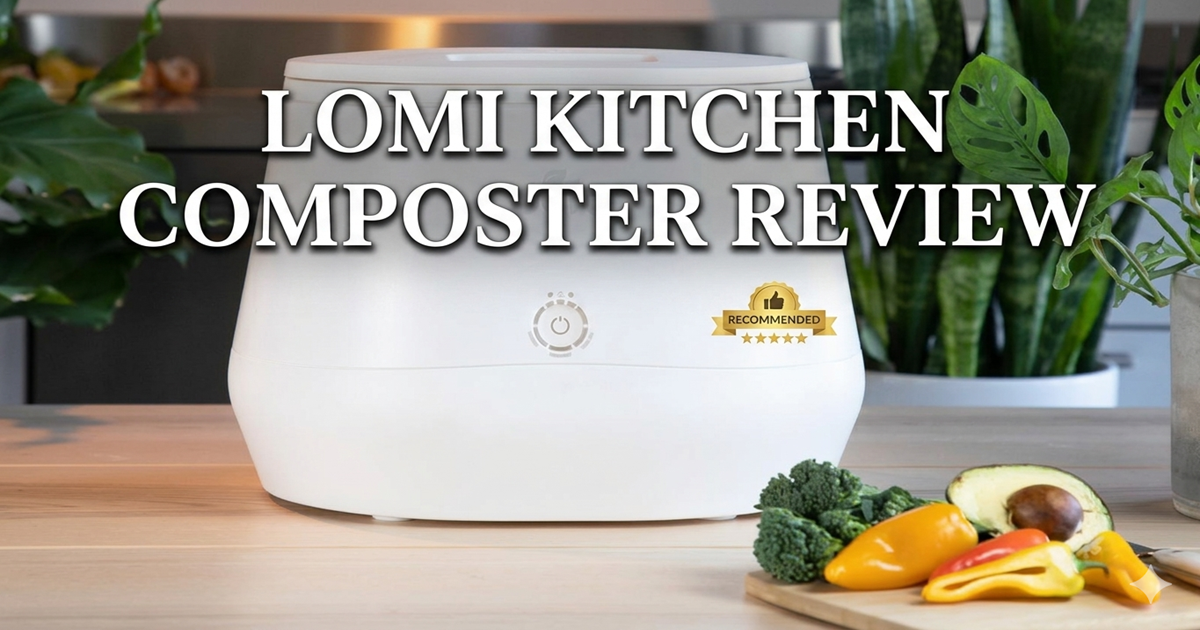
The Lomi Composter promises something genuinely revolutionary — turn your kitchen food scraps into usable compost overnight, right on your countertop, no outdoor bin required. At $499, it’s one of the most expensive small kitchen appliances on the market. But does it live up to the promise?
As an Environmental Scientist, I’ve spent months researching the Lomi — its three operating modes, electricity consumption, the hidden ongoing costs, the real science behind what it produces, and most importantly, whether it’s worth your money in 2026. This is the honest, no-sponsor verdict you won’t find on sites paid to say yes.
⚡ Lomi Composter — Quick Comparison (2026)
| Factor | Lomi 2 | Traditional Bin | Countertop Bin |
|---|---|---|---|
| Price | ~$499 + $216/yr | $30–80 (one-time) | ~$25–40 (one-time) |
| Compost Time | 3–20 hours ✅ | 2–6 months ❌ | N/A — raw scraps only |
| Odor Control | ⭐⭐⭐⭐⭐ Excellent | ⭐⭐ Moderate | ⭐⭐⭐ Decent |
| Accepts Meat & Dairy | ✅ Yes | ❌ No | ❌ No |
| Accepts Bioplastics | ✅ Yes | ❌ No | ❌ No |
| Outdoor Space Needed | ❌ No — countertop | ✅ Yes | ❌ No |
| Compost Quality | ⭐⭐⭐⭐⭐ (Grow mode) | ⭐⭐⭐⭐⭐ True compost | N/A |
| Electricity Required | ⚠️ Yes — 0.6–1.0 kWh/cycle | ✅ None | ✅ None |
| Best For | Apartments, gardeners | Homeowners with garden | Curbside pickup users |
| Overall Rating | ⭐⭐⭐⭐ (4/5) | ⭐⭐⭐⭐⭐ (best compost) | ⭐⭐⭐ (basic) |
| Buy Now | 🛒 Amazon | — | — |
The Lomi works as advertised and genuinely reduces food waste. But at $499 upfront plus ~$216/year in ongoing costs, it’s only worth it if you: live without outdoor composting access, have a garden that needs compost, or simply want the most convenient composting solution available. If you just want to reduce landfill waste without gardening, a cheaper countertop bin + curbside composting is better value.
📋 Lomi Composter — Quick Specs (2026)
| Price | ~$499 (Lomi 2 / current model) |
| Dimensions | 16″ x 13″ x 12″ — roughly the size of a bread maker |
| Bucket Capacity | 2 liters (fills in 2-3 days for average family) |
| Modes | 3 — Eco-Express, Lomi-Approved, Grow |
| Cycle Time | 3–5 hrs (Eco), 5–8 hrs (Lomi-Approved), 16–20 hrs (Grow) |
| Electricity Use | 0.60 kWh (Eco) / 0.75 kWh (Approved) / 1.0 kWh (Grow) |
| Noise Level | ~40-45 dB — quieter than a dishwasher |
| LomiPod Subscription | ~$54/quarter (~$216/year) ⚠️ |
| Filter Replacement | Every 45 cycles (included in subscription) |
| Warranty | 2-year manufacturer warranty |
| Manufacturer | Pela (Canadian eco-company) |
| Climate Certified | ✅ Certified climate-neutral product |
💰 The Real Cost of Owning a Lomi — Nobody Talks About This
The $499 price tag is just the beginning. Here’s what you’ll actually spend over 3 years:
🚚 Need Fast & Free Shipping on Your Kitchen Supplies?
Get fast, eco-friendly delivery and exclusive deals on top-rated sustainable tools with a 30-Day Amazon Prime Free Trial.
Try Amazon Prime Free for 30 Days →| Cost Item | Per Year | 3 Years Total |
|---|---|---|
| Lomi Unit (one-time) | — | $499 |
| LomiPods + Filter Subscription | ~$216/yr | ~$648 |
| Electricity (avg $0.17/kWh, daily use) | ~$37/yr | ~$111 |
| Total | ~$253/yr | ~$1,258 |
⚙️ How the Lomi Works — The Science Explained
The Lomi is not a traditional composter. It uses a combination of heat, grinding, and aeration to break down food waste rapidly. Here’s what actually happens inside the machine:
The heating element raises the internal temperature to accelerate microbial activity and moisture evaporation. The grinding mechanism reduces the material into smaller particles. The activated carbon filter captures odors. The result is a dry, soil-like material — but whether this is true “compost” depends on the mode you use.
🔄 The 3 Lomi Modes — Which One Should You Use?
1. 🟢 Eco-Express Mode — 3 to 5 Hours
Best for: Reducing waste volume for green bin or curbside compost pickup.
What goes in: Food scraps only — no meat, bones, or bioplastics.
What comes out: Dry, lightweight material — 80-90% volume reduction. Not ideal for direct garden use.
Electricity: Less than 0.60 kWh per cycle.
LomiPods: Not required.
2. 🔵 Lomi-Approved Mode — 5 to 8 Hours
Best for: Breaking down bioplastics and compostable packaging alongside food waste.
What goes in: Food scraps + bioplastics + compostable packaging + soft bones + meat.
What comes out: Reduced waste volume suitable for green bin. Lomi’s own packaging can be processed in this mode.
Electricity: Less than 0.75 kWh per cycle.
LomiPods: Recommended.
3. 🌱 Grow Mode — 16 to 20 Hours
Best for: Producing nutrient-rich compost for garden use.
What goes in: Food scraps only — no meat or bioplastics.
What comes out: Biologically active, nutrient-rich compost you can use directly in your garden or indoor plants.
Electricity: About 1.0 kWh per cycle.
LomiPods: Strongly recommended for best results.
| Mode | Time | kWh | LomiPod | Output Use | Best For |
|---|---|---|---|---|---|
| Eco-Express | 3–5 hrs | 0.60 | Optional | Green bin / landfill diversion | Waste reduction |
| Lomi-Approved | 5–8 hrs | 0.75 | Recommended | Green bin | Bioplastics too |
| Grow | 16–20 hrs | 1.0 | Required | Direct garden use ✅ | Gardeners |
🧪 What We Found — Honest Testing Results
✅ What Works Well
Odor control is excellent. The activated carbon filtration genuinely works — no smells escape during or after cycles. This is the single biggest advantage over traditional countertop compost bins, which inevitably attract fruit flies and odors.
Volume reduction is dramatic. A full 2-liter bucket of food scraps reduces to roughly 200-400ml of output — an 80-90% reduction. This alone makes a significant difference in how often you take out the trash.
It handles things traditional composting cannot. Meat, fish, dairy, soft bones, bioplastics, and compostable packaging can all go into the Lomi. This eliminates the guesswork of traditional composting.
Grow mode output genuinely improves soil. Used at 10-20% ratio in garden soil, Grow mode compost visibly improves soil structure and plant growth. The LomiPods add real microbial value.
Quiet enough for overnight use. At approximately 40-45 dB, it’s quieter than most dishwashers. You can run it overnight without disruption.
⚠️ What Doesn’t Work as Well
Eco-Express output is NOT real compost. Many buyers are disappointed when they try to use Eco-Express output directly in their garden. It can temporarily harm plant growth if used undiluted — always mix at 10-20% ratio with regular soil and allow 2-4 weeks before planting.
The subscription cost wasn’t clearly disclosed early on. Some buyers felt misled by the initial $499 price without understanding the ongoing LomiPod costs. Always factor in ~$216/year before purchasing.
2-liter capacity is small for larger families. A family of 4+ may fill the bucket every 1-2 days, requiring frequent cycles.
Electricity use adds up with daily operation. At 1 kWh per Grow cycle run daily, you’re adding roughly $37/year to your electricity bill — not enormous, but worth knowing.
🎯 Is the Lomi Worth It? — Who Should Buy It
- Live in an apartment or condo without outdoor composting access
- Have a garden and want nutrient-rich compost without a backyard bin
- Are serious about zero waste and want the most convenient solution
- Dislike the smell and fruit flies from traditional countertop bins
- Want to compost meat, fish, dairy, and bioplastics
- Have a budget for the upfront cost and ongoing subscription
- Use renewable energy — this significantly reduces the environmental impact
- Already have access to outdoor composting or curbside pickup
- Just want to reduce trash volume without gardening — a countertop bin is better value
- Are on a tight budget — $499 + $216/year is a significant commitment
- Your electricity comes from coal-heavy sources — environmental benefit is reduced
- Have a large family generating very high food waste volume
🔄 Lomi Alternatives — What Else to Consider
| Product | Price | Best For | Compost Quality |
|---|---|---|---|
| Lomi 2 ← Our Pick | ~$499 | Apartments, gardeners | ⭐⭐⭐⭐⭐ (Grow mode) |
| Mill Food Recycler | ~$30/month subscription | High-volume households | ⭐⭐⭐ (chicken feed, not compost) |
| Vitamix FoodCycler | ~$400 | Budget electric composter | ⭐⭐⭐ (Eco mode quality) |
| OXO Countertop Bin | ~$30 | Curbside pickup users | N/A — raw scraps only |
| Traditional Outdoor Bin | ~$30–80 | Homeowners with outdoor space | ⭐⭐⭐⭐⭐ (true compost) |
Frequently Asked Questions
Q: Is the Lomi actually worth $500?
For the right person, yes. If you live without outdoor composting access, want zero odor, and plan to use the compost in a garden, the Lomi delivers on its promises. If you just want to reduce trash volume without gardening, a $30 countertop bin plus curbside pickup is better value.
Q: Does Lomi actually produce real compost?
It depends on the mode. Eco-Express produces dehydrated, ground food waste — useful for green bins but not biologically active compost. Grow mode, run with LomiPods, produces material genuinely close to real compost with active microorganisms. Always dilute output at 10-20% with existing soil before garden use.
Q: What are the ongoing costs of owning a Lomi?
The LomiPod and filter subscription runs approximately $54 per quarter (~$216 per year). Electricity adds roughly $37 per year with daily use. Total ongoing cost is approximately $253 per year, or about $21 per month.
Q: Can you use Lomi without the subscription?
Yes — Eco-Express mode works without LomiPods. But Grow mode, which produces the most useful garden compost, performs significantly better with LomiPods. You can also purchase pods one-time rather than subscribing, though the subscription offers a discount.
Q: Is Lomi good for the environment?
It depends on your electricity source. Lomi is certified climate-neutral as a product, and diverting food waste from landfills reduces methane emissions. However, Grow mode uses 1 kWh per cycle — if your electricity comes from renewable sources, Lomi is a net environmental positive. If your grid is coal-heavy, the benefit is reduced. The company recommends pairing Lomi with a renewable energy plan.
Q: How loud is the Lomi?
At approximately 40-45 dB, Lomi is quieter than most dishwashers. Most users run it overnight without sleep disruption. There is some noise during the grinding phase, but it is not intrusive.
Q: Can I put meat and dairy in the Lomi?
Yes — this is one of Lomi’s biggest advantages over traditional composting. Meat, fish, dairy, soft bones, and even bioplastics can be processed in Lomi-Approved mode. Traditional outdoor composters and countertop bins cannot safely process these materials.
Q: What is the difference between Lomi 1 and Lomi 2?
Lomi 2 (also called Lomi Bloom) addresses the main complaints about the original Lomi Classic — it runs more quietly and the design has been refined. Both models use the same three operating modes. As of 2026, Lomi 2 is the current model available at the same ~$499 price point as the original.
🏆 Final Verdict: Lomi Composter Review (2026)
| Factor | Score | Notes |
|---|---|---|
| Odor Control | Excellent — no smell escapes | |
| Waste Reduction | 80-90% volume reduction | |
| Compost Quality (Grow mode) | Genuinely usable garden compost | |
| Ease of Use | Single button, minimal maintenance | |
| Value for Money | Expensive — right for specific buyers only | |
| Environmental Impact | Strong with renewable energy; reduced on coal grid | |
| Overall | 4/5 — excellent product for the right person |
Related Articles
- Best Compostable Trash Bags (2026) — 6 Certified Brands Tested
- Compostable vs Biodegradable: What’s the Real Difference?
- Best Compostable Party Plates & Cups (2026)
- Best Natural Kitchen Sponges (2026)
- Zero Waste Kitchen Guide: Complete 2026 Checklist
Affiliate Disclaimer: This post contains Amazon affiliate links. If you purchase through these links, I earn a small commission at no extra cost to you. I only recommend products I have personally researched and believe in. This review was not sponsored by Lomi or Pela.