
| ⚡ Quick Answer |
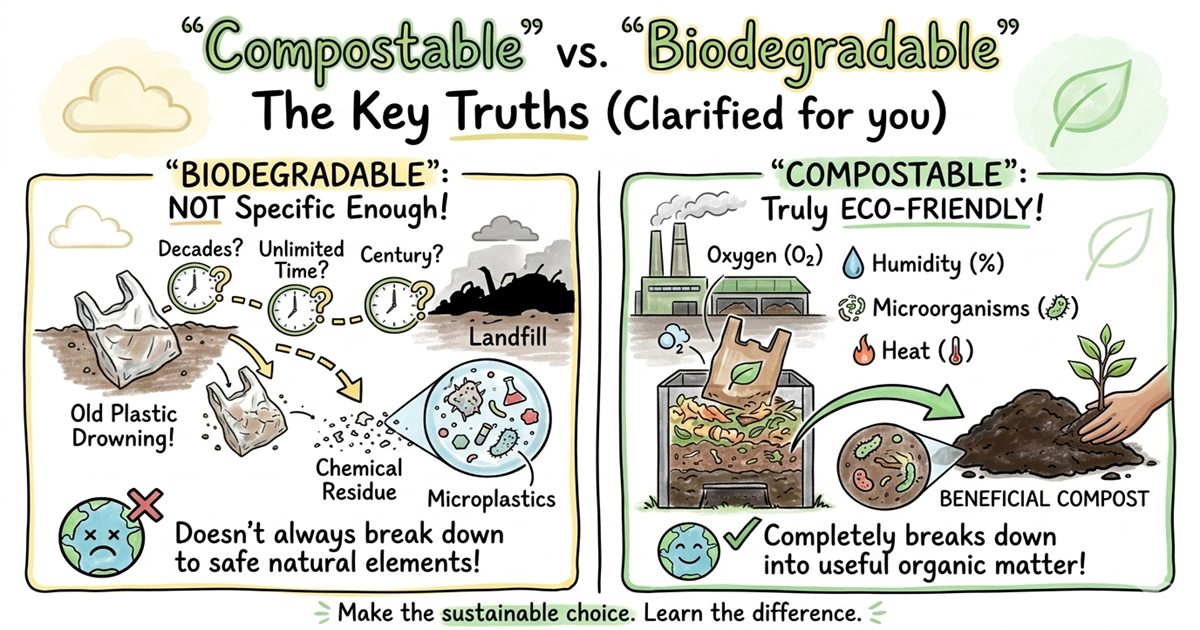
| ✅ Compostable: Breaks down into nutrient-rich compost within 90-180 days under specific conditions. Must be certified (ASTM D6400, BPI, EN 13432). ⚠️ Biodegradable: Breaks down eventually — but no time limit, no specific conditions, no certification required. Could take decades. ❌ Oxo-degradable: Fragments into microplastics. NOT eco-friendly despite marketing claims. Banned in EU. 🔑 Key Rule: All compostable products are biodegradable, but NOT all biodegradable products are compostable. Always look for certification logos. |
Why This Confusion Costs the Planet Billions Every Year
Every year, millions of people buy products labeled ‘biodegradable’ thinking they’re making the eco-friendly choice — only to have those products end up in landfills, breaking down just as slowly as conventional plastic.
The terms ‘compostable’ and ‘biodegradable’ are not interchangeable. Using them as if they are has led to widespread greenwashing, contaminated recycling streams, and products that do more harm than good.
As an Environmental Scientist, I see this confusion every day. In this guide, I’m going to explain the scientific difference in plain English — and show you exactly which kitchen products are genuinely eco-friendly versus which ones are just clever marketing.
🚚 Need Fast & Free Shipping on Your Kitchen Supplies?
Get fast, eco-friendly delivery and exclusive deals on top-rated sustainable tools with a 30-Day Amazon Prime Free Trial.
Try Amazon Prime Free for 30 Days →If you’re building a zero-waste kitchen, start with our guide to the best compostable trash bags, then come back here to understand exactly why certification matters.
Compostable vs Biodegradable vs Oxo-degradable — Full Comparison
Here’s the complete breakdown of every term you’ll encounter on eco-friendly product packaging:
| Term | Definition | Timeframe | Conditions | Certified? | Eco-Friendly? |
| ✅ Compostable | Breaks down into nutrient-rich compost | 90-180 days | Industrial facility (55-65°C) | Required (ASTM D6400, BPI) | ✅ Yes — creates compost |
| 🏠 Home Compostable | Breaks down in backyard bin | 180-365 days | Home compost (25-45°C) | Required (OK Compost Home) | ✅ Yes — best option |
| ⚠️ Biodegradable | Breaks down eventually | Months to centuries | No specific conditions | Not required | ⚠️ Maybe — depends on product |
| ❌ Oxo-degradable | Fragments into microplastics | Varies | UV light + heat | No standard | ❌ No — worse than plastic |
| ♻️ Recyclable | Can be processed into new material | Depends on facility | Recycling facility | Varies by material | Can be processed into a new material |
What Does ‘Compostable’ Actually Mean?
The Scientific Definition
A product is compostable if it meets the following scientific criteria under ASTM D6400 or EN 13432 standards:
- 90% of the material breaks down within 180 days
- Breakdown occurs at 58°C ± 2°C under controlled moisture and microbial conditions
- No toxic residue is left behind — safe for soil and plants
- Heavy metals and harmful chemicals remain below regulatory thresholds
🔬 Scientist’s Note: The 58°C requirement is critical — it’s why most certified compostable products only break down in industrial composting facilities, where temperatures are precisely controlled. Your home compost bin typically reaches 25-45°C, which is insufficient for industrial-grade compostable materials.
Industrial Composting vs Home Composting
| Factor | 🏭 Industrial Composting | 🏠 Home Composting |
| Temperature | 55-65°C (controlled) | 25-45°C (ambient) |
| Breakdown time | 90-180 days | 180-365 days |
| Accepts | ASTM D6400, BPI, EN 13432 | OK Compost Home only |
| Availability | City programs, green bins | Your backyard bin |
| Best bags to use | AIRNEX, BioBag, Glad, Unni | AIRNEX, If You Care, BioBag |
What Does ‘Biodegradable’ Actually Mean?
The Scientific Definition
According to the Ellen MacArthur Foundation, biodegradable means: able to be broken down into carbon dioxide, water, and biomass by the natural action of microorganisms over an unspecified length of time and in undefined conditions.
The critical phrase is ‘unspecified length of time.’ Technically, even conventional plastic is biodegradable — it just takes 500+ years. This is why the FTC’s Green Guides (§260.8(c)) require companies to provide scientific evidence that a product will fully decompose within one year under typical environmental conditions to legally claim biodegradability.
| The Problem with ‘Biodegradable’ Claims: No independent certification required — any company can print ‘biodegradable’ on any product. No time limit specified — could mean 1 year or 1,000 years. No conditions specified — may require industrial facility to break down anyway. The FTC has issued warning letters to companies making misleading biodegradable claims Scientific Reference: FTC Green Guides §260.8(c) — ‘It is deceptive to make an unqualified degradable claim for items entering the solid waste stream if the items do not completely decompose within one year after customary disposal.’ |
Oxo-degradable: The Worst Option
Oxo-degradable plastics are conventional plastics mixed with additives that cause them to fragment into smaller pieces when exposed to UV light and heat. They are marketed as ‘biodegradable’ — but this is scientifically misleading and environmentally harmful.
These products do not biodegrade — they fragment into microplastics. The EU banned oxo-degradable plastics in 2021 under the Single-Use Plastics Directive (EU 2019/904). They contaminate both composting and recycling streams and should be avoided entirely.
| 🚨 Greenwashing Alert — Watch Out For These Claims |
| These labels mean NOTHING without certification: ❌ ‘Eco-friendly’ — no legal definition, no standard ❌ ‘Green’ — marketing term only ❌ ‘Natural’ — no regulated standard for packaging ❌ ‘Plant-based’ — material only, says nothing about breakdown ❌ ‘Biodegradable’ alone — no timeframe, no conditions specified ✅ ALWAYS look for: ASTM D6400, BPI Certified, EN 13432, or OK Compost Home logos on the packaging. |
Certifications That Actually Matter — Full Guide
The only way to know if a product is genuinely compostable is to look for independent certification. Here’s every certification you need to know:
| Certification | Organization | Country | Scope | Trusted? | Notes |
| ASTM D6400 | ASTM International | 🇺🇸 USA | Industrial | ✅ Yes | Most common in USA — required for BPI certification |
| BPI Certified | Biodegradable Products Inst. | 🇺🇸 USA | Industrial | ✅ Yes | Independent verification of ASTM D6400 |
| EN 13432 | European Standard | 🇪🇺 EU | Industrial | ✅ Yes | European equivalent of ASTM D6400 |
| OK Compost Home | TUV Austria | 🌍 Global | Home compost | ✅ Yes | Strictest home composting standard — gold standard |
| Seedling Logo | European Bioplastics | 🇪🇺 EU | Industrial | ✅ Yes | Common on European products |
| ‘Biodegradable’ (no cert) | N/A — unverified | Anywhere | Unknown | ❌ No | No standard, no testing, often greenwashing |
| ‘Eco-friendly’ (no cert) | N/A — marketing only | Anywhere | Unknown | ❌ No | Meaningless without certification |
🛒 Compostable Kitchen Products — What to Buy (2026)
Now that you understand the difference, here are the genuinely certified compostable kitchen products worth buying. Every product below carries independent third-party certification:
| Product | Type | Certification | Home Compost | Industrial | Buy |
| AIRNEX Compostable Bags | Trash bags | BPI, OK Compost Home | ✅ Yes | ✅ Yes | 🛒 Amazon |
| BioBag Compostable Bags | Trash bags | ASTM D6400, BPI | ✅ Yes | ✅ Yes | 🛒 Amazon |
| Glad ForceFlexPlus Compost. | Trash bags | BPI, ASTM D6400 | ❌ No | ✅ Yes | 🛒 Amazon |
| Unni 100% Compostable | Trash bags | ASTM D6400, BPI | ✅ Yes | ✅ Yes | 🛒 Amazon |
| If You Care Bags | Trash bags | OK Compost Home | ✅ Yes | ✅ Yes | 🛒 Amazon |
| Repurpose Party Plates | Plates | BPI Certified | ❌ No | ✅ Yes | 🛒 Amazon |
| ECO SOUL Bagasse Plates | Plates | BPI, ASTM D6400 | ❌ No | ✅ Yes | 🛒 Amazon |
| SUPERSCANDI Bamboo Plates | Plates | FSC, OEKO-TEX | ✅ Yes | ✅ Yes | 🛒 Amazon |
| Swedish Dishcloths (Skoy) | Cleaning | Compostable cert | ✅ Yes | ✅ Yes | 🛒 Amazon |
| Bamboo Dish Brush | Cleaning | FSC Certified | ✅ Yes | ✅ Yes | 🛒 Amazon |
| 🌿 Our Top Pick: AIRNEX Compostable Trash Bags |
| If you’re looking for a compostable trash bag that meets the highest standards — both industrial AND home composting — AIRNEX is our top recommendation. Why AIRNEX stands out: ✅ BPI Certified (ASTM D6400) — industrial composting ✅ OK Compost Home (TUV Austria) — home composting ✅ 100% cornstarch — fully plant-based, no plastic ✅ Available: 1.6 Gal, 8 Gal, 13 Gal, 33 Gal ✅ Leakproof, tearproof — 15 lb capacity 🛒 Small Compost Bags 1.6 Gal 🛒 Compostable Kitchen Trash Bags 13 Gal 🛒 Compostable Kitchen Trash Bags 33 Gal |
Frequently Asked Questions
Q: Is compostable better than biodegradable?
Yes — in almost every case. Compostable products have a defined timeframe (90-180 days), specific breakdown conditions, and leave behind nutrient-rich compost rather than just carbon dioxide and water. Biodegradable is an unregulated term that tells you very little about a product’s actual environmental impact.
Q: Can I put biodegradable products in my compost bin?
Only if they carry the OK Compost Home certification. Products labeled simply ‘biodegradable’ may not break down in home composting conditions and can contaminate your compost. Always look for certified compostable — not just biodegradable.
Q: Are compostable trash bags worth it?
Yes — if you have access to a composting program (curbside collection or home composting). Certified compostable bags like AIRNEX and BioBag genuinely break down into harmless compost. If you don’t have access to composting, they still biodegrade faster than conventional plastic in a landfill.
Q: Are compostable plates and cups actually compostable?
Most certified ones are — but always check for BPI or ASTM D6400 certification. Our guide to the best compostable party plates and cups covers exactly which brands are genuinely certified and which are greenwashing.
Q: Is beeswax wrap compostable or biodegradable?
Beeswax wraps made from 100% natural ingredients (cotton, beeswax, tree resin, jojoba oil) are genuinely home compostable. Our beeswax wraps review explains exactly what to look for and which brands use pure natural ingredients.
Q: Are Swedish dishcloths compostable?
Yes — Swedish dishcloths made from cellulose and cotton are 100% home compostable. They’re one of the best zero-waste swaps you can make in your kitchen. See our full Swedish dishcloth review for the top certified brands.
📎 Related Articles
⚠️ Affiliate Disclosure: This post contains Amazon affiliate links. If you purchase through our links, we may earn a small commission at no extra cost to you. This never influences our recommendations.